Countering Hate, Cultivating Joy: From West Virginia to the Nation
What do you picture when someone says “people of faith?” Does it change if someone adds “in West Virginia” to the end of that phrase?
The prevailing national narrative says that West Virginia is a state reserved for right-wing Christians. A state where LGBTQ+ people can’t live openly, where there aren’t any people of color, where Muslims, Sikhs and Jews could only ever feel unsafe.
We at the West Virginia Faith Collective don’t buy into that narrative because we see interfaith communities in our state fighting for social justice every day. So instead of treating West Virginia like a problem to solve, we asked a different question: What if we viewed our state as a place with something to teach organizers and faith leaders from other parts of the country?
This was the idea behind the “Countering Hate, Cultivating Joy” summit, a multi-day interfaith gathering that we co-hosted in Charleston last month with Interfaith Alliance, a national nonprofit that unites people of diverse faiths and beliefs to build a resilient democracy and fulfill America’s promise of religious freedom and civil rights.
More than 50 faith leaders, community organizers and artists from Central Appalachia and the Mid-Atlantic came together at the summit to build relationships, share knowledge and embrace art as a tool to resist authoritarianism, Christian Nationalism and bigotry.
“I was just blown away by the type of organizing happening in West Virginia, and it felt like an exciting place to make this investment,” said Zev Mishell.
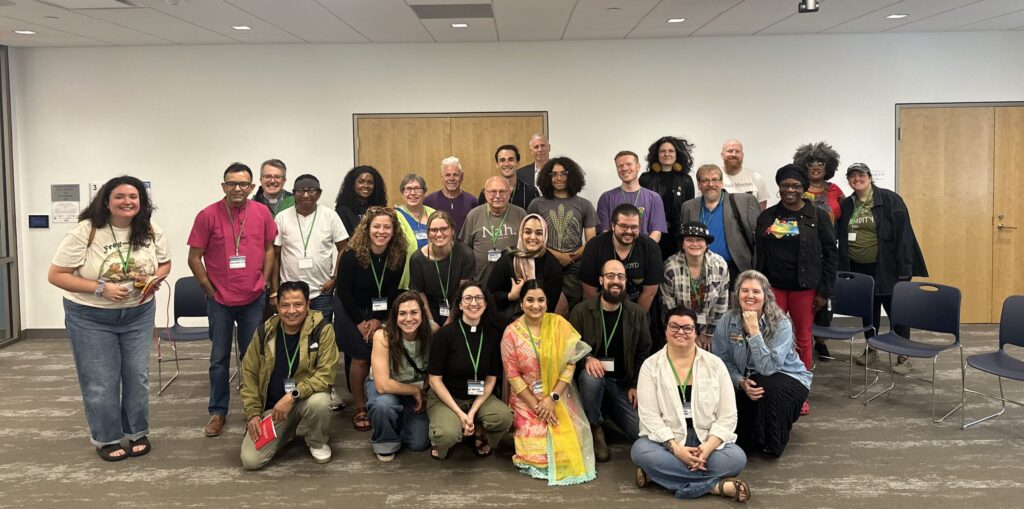
Some of the conference participants pose after the closing interfaith worship service.
Mishell has worked as Interfaith Alliance’s senior programs strategist for the past two years. In that role, he’s seen the chronic national community organizing disinvestment in states like West Virginia.
“I’m personally very skeptical of these red state stereotypes, which is a part of what I’m trying to reverse in my work,” Mishell said. “The assumption that people in these states only want a particular type of far-right policy just always struck me as wrong.”
Mishell’s skepticism of those prevailing narratives was supported by the diverse group of Appalachian speakers, workshop leaders and artists that filled the summit’s schedule.
Mutual Aid, Art as Resistance, Sustainable Futures & More
Interfaith Alliance’s Senior Adviser Maggie Siddiqi, Campaigns Director Adam Friedman, and Mishell led several workshops focused on interfaith engagement during a time of rising Islamophobia, antisemitism and Christian Nationalism. Together, we examined the ways these forms of bigotry reinforce one another and developed strategies for building cross-faith solidarity. For many attendees and organizers, faith is what moves them to fight for social justice.
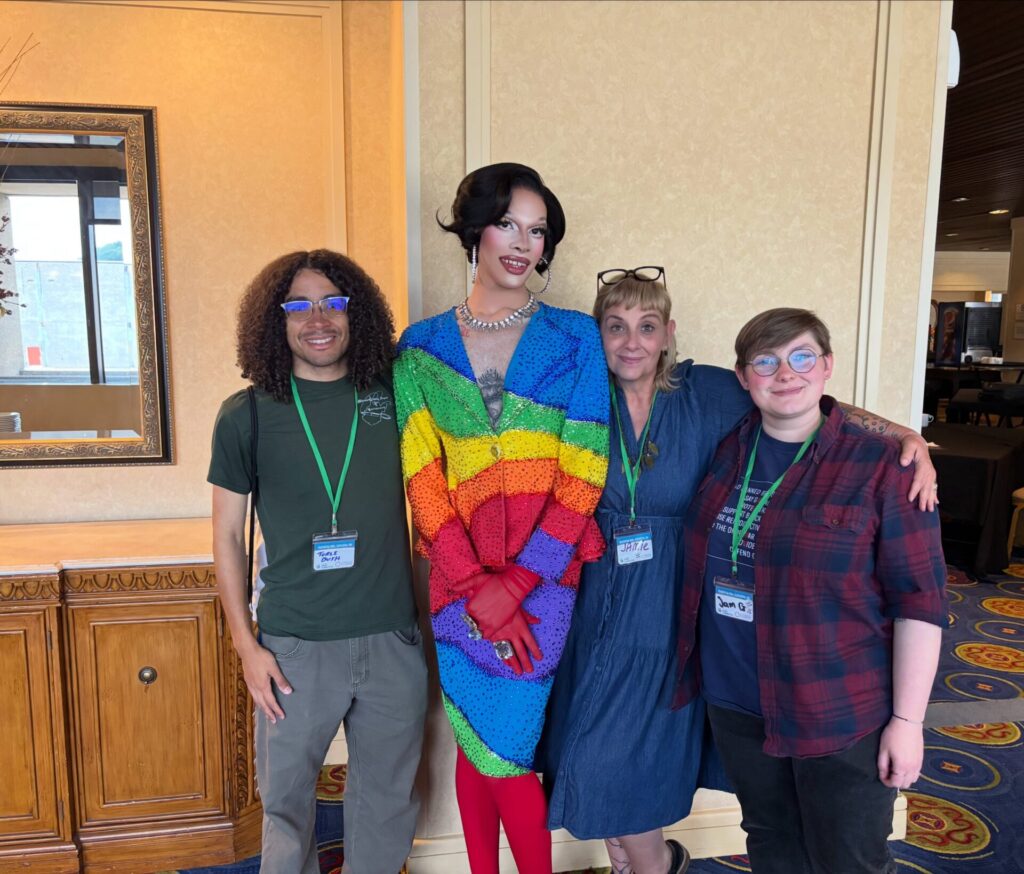
pictured: Art as Resistance workshop leaders Torli Bush, Thee Nyshyne, Jamie Miller, and Sam Green
“There’s a famous passage from a Jewish rabbinic book called ‘Pirkei Avot,’ or ‘The Teachings of our Fathers.’ It says that you are not compelled to finish the work, but neither are you free to desist from it,” said Mishell, who is Jewish. “And that’s just a very important value for me: Something is wrong. It shouldn’t be wrong. And we should all work together to try to make it right.”
Several members of the West Virginia Faith Collective leadership team also led workshops.
From Below Co-Chairs Rev. Brad Davis and Rev. Caitlin Ware hosted a “Preparing for a Sustainable Future” workshop. They were joined by Jason Tartt, an entrepreneur, farmer and community advocate based in McDowell County. Their discussion explored the impact authoritarianism has on food systems and landscapes.
Revs. Cindy Briggs-Biondi and Darick Biondi also shared a condensed version of their Disrupting Empire training, during “Tools for Resisting Christian Nationalism.”
West Virginia Mutual aid practitioners Brittney Barlett and Heather Schneider were joined by Destiny Kelley to lead a “Mutual Aid 101” workshop, teaching faith leaders about the foundations and practices of mutual aid. Kelley spoke about her work with The Revolution KY, the grassroots collective liberation organization she founded to serve her state’s rural communities.
The Revolution KY is currently building an alternative medical system for people who can’t access or afford the care they need.
“We do free community medic training and rapid response, including ‘Stop the Bleed’ tourniquet training,” Kelley said. “Our goal is to build enough first response medic teams in every single community across the state, so that we don’t have to rely on ambulance service centers or have no care on the way to the hospital.”
Roughly 300,000 Kentuckians are uninsured, and some of the state’s EMS systems are reducing services or considering closing due to funding constraints.
Iconic West Virginia drag queen Thee Nyshyne spoke — and performed – at our Art as Resistance workshop. She was joined by visual artist Jamie Miller, community organizer Sam Green and poet Torli Bush on a panel of makers.
“I never felt like an artist growing up. And then something shifted when I was in high school, and I started learning about drag makeup and theater expression. I found my niche that way,” said Nyshyne, who lives in Huntington. “With the landscape of the world right now, art and drag are under a microscope and under attack.”
Although Nshyne is not a person of faith, she spoke about the importance of being welcomed in faith spaces and the many misconceptions people have about West Virginia.
“Its historical ties would make people think that, queer people, people of color or Black people can’t feel comfortable here,” Nyshyne said. “But, as a queer Black person, I felt super, super comfortable being in that room, not only in Appalachia, but surrounded by faith groups and faith leaders. I felt like a leader with them.”
Centering Joy and Unity
“We must be nourished in order to engage and dismantle authoritarianism, Islamaphobia, and antisemitism,” said our executive director Rev. Jenny Williams. “Leaders from historically marginalized populations have consistently centered joy in their movement work, and we wanted to cultivate joy in this summit through the arts.”
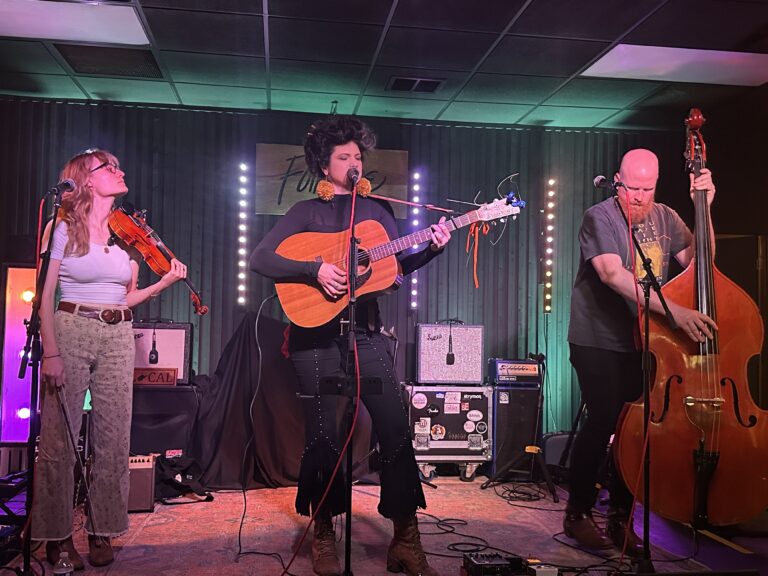
Restorative Practitioner Dr. Shanequa Smith of Charleston, WV opened the summit with a keynote address on the role of joy in collective resistance. The second day culminated in a free performance by fifth-generation West Virginia musician Heather Hannah at Folklore Music Exchange,
Prior to many of our sessions, Affrilachian poet Torli Bush read a number of their poems, centering Appalachian imagery and themes. And throughout the summit, we were led in communal singing by Morgantown-based choral scholar, director and music educator Dr. Natalie Shaffer.
Attendees joined in simple rounds, singing uplifting music that was reminiscent of Christian gospel, yet distinctly non-denominational. Other songs focused specifically on social justice, including “Solidarity Forever,” a classic pro-union song.
“With any organized religion, anything that is sung is more elevated,” Shaffer said. “We learn about songs that have been passed down in other religions, but it’s the same in communities, especially in Appalachia. Songs are passed down. Songs tell stories. But the stories are more than just a recounting of events.”
Shaffer’s work has focused on creating collaborative social justice through choral music making. She’s led a choir for people experiencing homelessness, frequently leads singing at protests and vigils in Morgantown and is involved with the Singing Resistance movement.
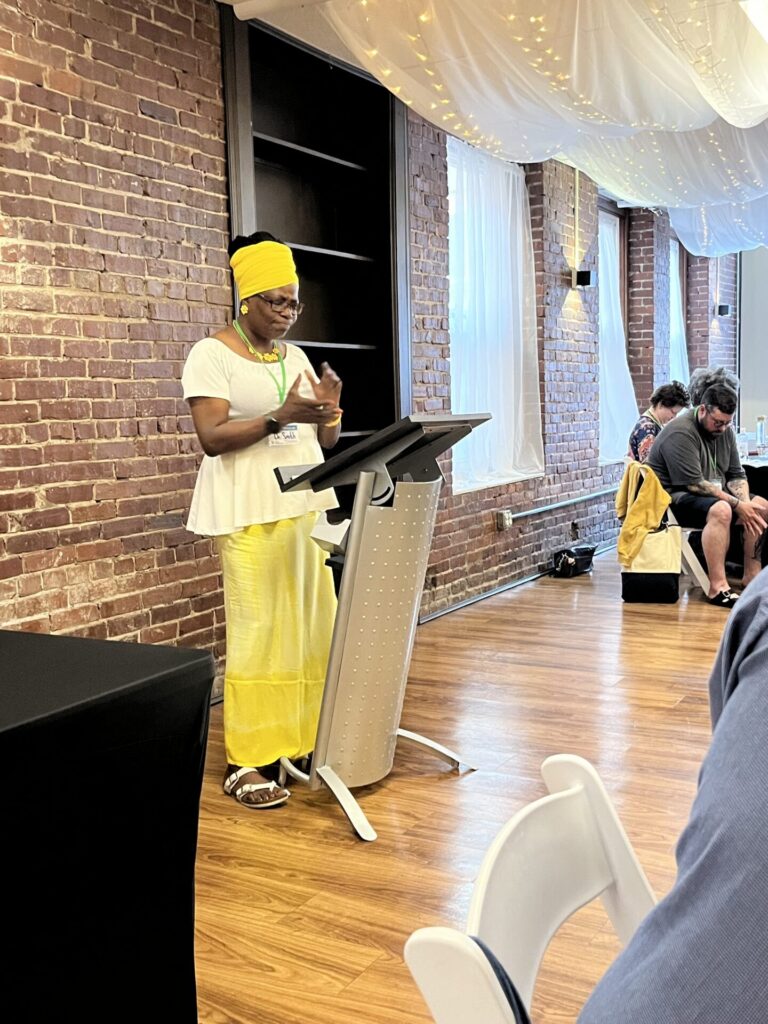
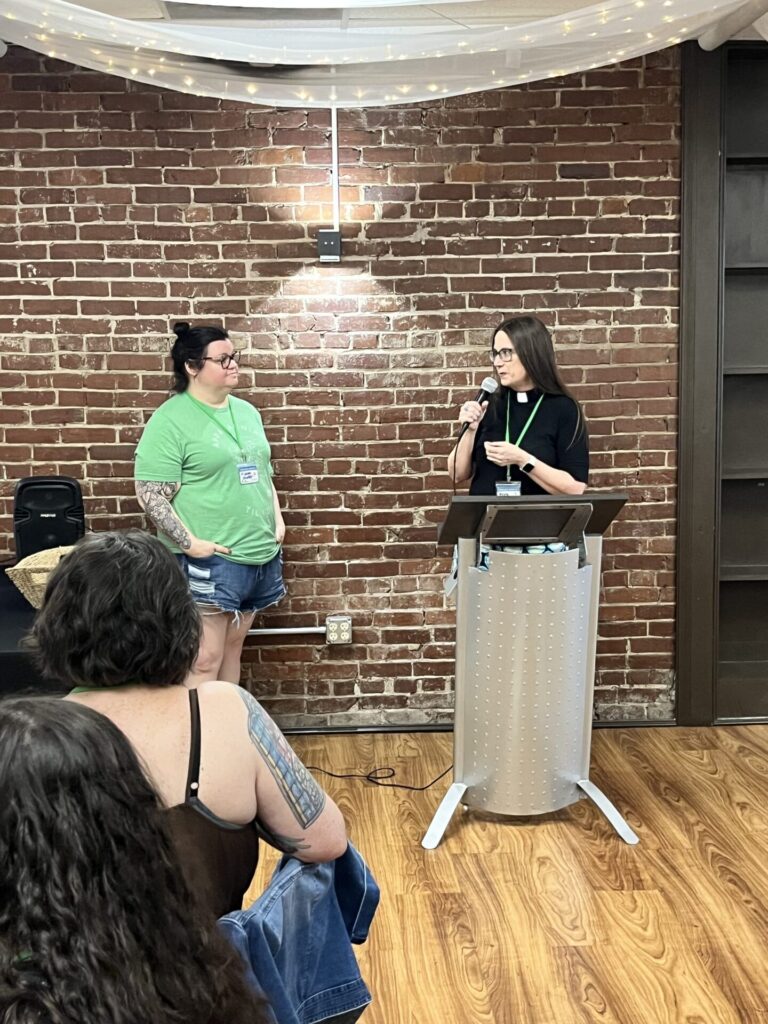
Dr. Shanequa Smith Dr. Natalie Shaffer and Rev. Jenny Williams
“After about 10 minutes or so of singing in a group of people, if you’re breathing together and singing together, your heart rates drop. They unify,” Shaffer said. “It’s really good for your blood pressure, and it’s really good for your mental health.”
People’s spirits were also lifted during a moving interfaith service that helped wrap up the summit. Attendees heard reflections from Christian, Muslim, Jewish, Sikh, Hindu, Buddhist and Pagan perspectives.
“We felt like we were not alone,” said Sudarshan Pyakurel, a Hindu and the executive director of Bhutanese Community of Central Ohio. “We see that there is some sort of movement, even if it’s underground, even if it’s low key, even if it’s low-funded. What matters is that there are people concerned about these issues and willing to come out, speak up, and think about how we can unite. Because that’s more important than how we pray.”
Both Pagan attendees were initially surprised to be invited at all.
“People have really, really upsettingly incorrect ideas [about Pagan traditions],” said Dottie Burcham from Metro Valley Pagan Pride. “They kind of treat it like it’s not real. They treat our Gods like delusions. So, to be treated like an adult, it was just a legitimization of so many different faith paths. And we were just so happy to be there.”
There was one particularly striking moment of interfaith solidarity during the closing service as Jai Johnson, another Pagan from West Virginia, began to speak.
“Being a person of color, not being Christian, walking an alternative path, I have been looked at funny, talked about, not quite threatened, but made to feel different,” Johnson said. “And instead, I was amazed. It was a really heartwarming experience, and we were welcomed in a way that we normally are not.”
That feeling of welcome was so moving that Johnson began to cry and struggled to read the reflection she’d written for the service.
“So, I’m bawling my eyes out, and without skipping a beat, tissues start coming around the circle,” Johnson said.
Fatimah Popal, a practicing Muslim and co-founder of the Virginia nonprofit MakeSpace, had a spare pack of tissues in her purse. Person by person, they were passed around the room slowly, until they reached Johnson, who was sitting on the other side of the room.
“Tissues just came out of the air, you know? And to have someone listening to me, knowing that I was feeling something, not hesitating to help me, that meant a lot.”